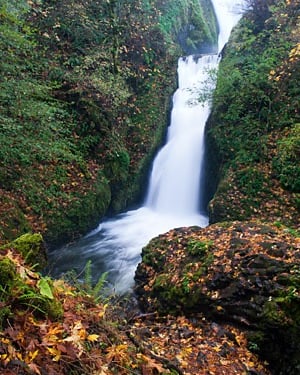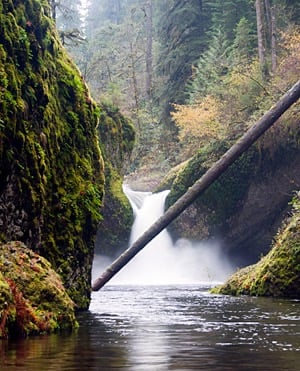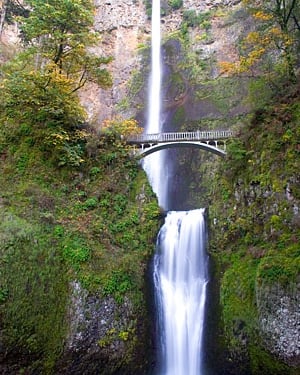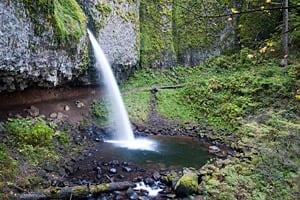
Vertical basalt walls along the Columbia River Gorge are graced with the greatest concentration of waterfalls in North America, particularly along the Oregon side of the western Gorge

Why are there fewer waterfalls on the Washington side of the Columbia River? The Washington side faces south and receives more sunlight, so it's drier. But more importantly, is the geology. The Washington side is an unstable "layer cake" of dense basalt on top of softer, unconsolidated rocks, and the whole assembly tilts to the south as it follows the buried slope of an extinct volcano. Earthquakes and ground saturation have given rise to numerous landslides, which have reduced the slope along the Washington side of the western Gorge. With fewer vertical drops, there are fewer waterfalls.

Waterfall Types

BLOCK
A block waterfall descends over a wide, nearly vertical rock face where the water maintains a broad, rectangular shape as it falls. Unlike tiered or fan waterfalls, the flow remains relatively uniform from top to bottom, with little to no narrowing, spreading, or stepping. The water appears as a solid sheet or thick curtain, dropping cleanly in a single dominant fall. The edges are usually well defined, giving the waterfall a strong, bold silhouette. Block waterfalls commonly form where resistant bedrock creates a sharp cliff edge, with dark, wet stone surfaces and concentrated mist and plunge pool activity at the base.

In the Columbia River Gorge, well-known examples of block or block-like waterfalls include Latourell Falls, which drops in a wide, rectangular sheet over a vertical basalt wall; Bridal Veil Falls (upper fall), where the water descends in a strong, uniform curtain; and Upper Falls at Falls Creek, which often presents a broad, blocky drop during higher flow.

CASCADE
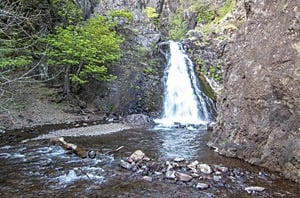
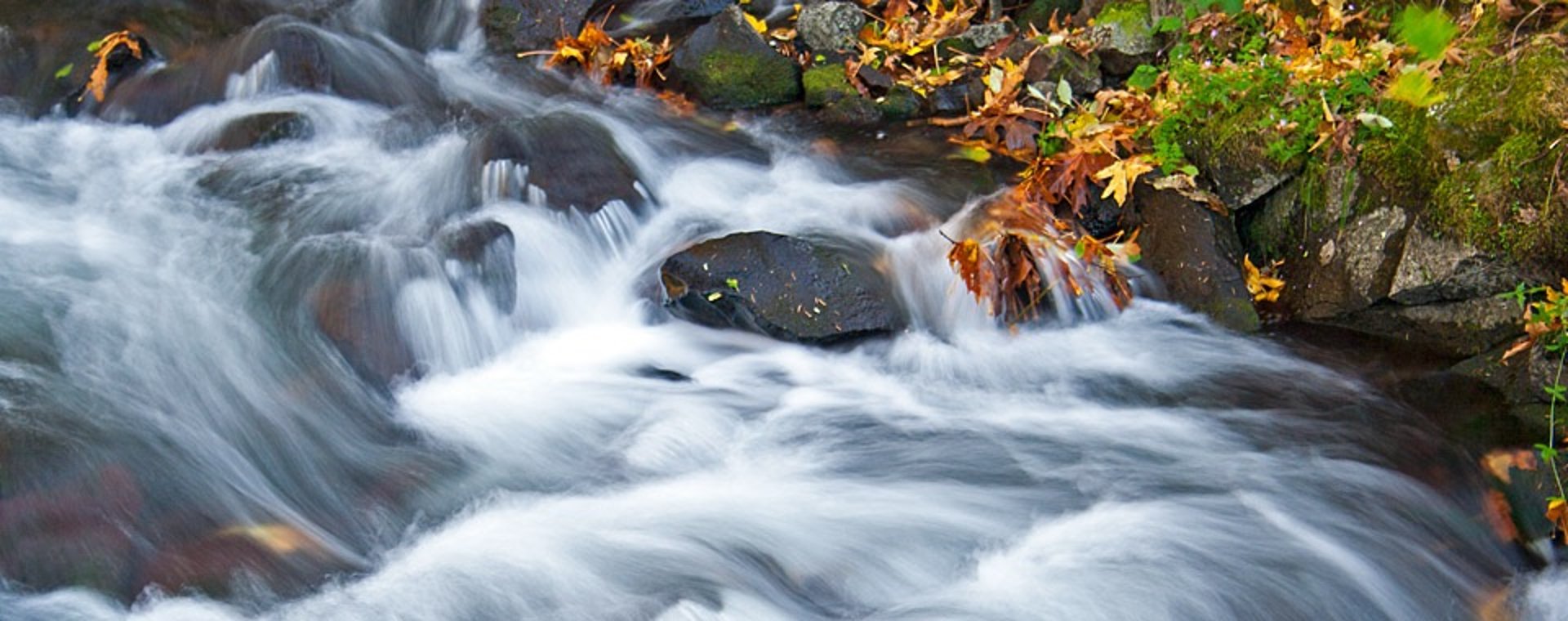
A cascade waterfall descends down a sloping or stepped rock surface rather than dropping vertically. Water flows continuously over uneven rock, breaking into multiple small streams and rivulets as it moves downward. The flow follows the contours of the rock face, creating a lively, textured appearance with visible motion along the entire slope. Cascades often spread laterally, with water weaving around protruding stones, forming whitewater, splashes, and small drops instead of a single plunge. The overall look is energetic and dynamic, with wet, sculpted rock surfaces, shallow chutes, and minimal plunge pooling compared to vertical falls.

In the Columbia River Gorge, notable cascade or cascade-dominant waterfalls include Wahclella Falls, where water flows down a sloped basalt face in a broad cascade; Elowah Falls, which combines cascading flow with a short plunge; Gorton Creek Falls, known for its fast-moving, broken cascades over bedrock; and Dry Creek Falls, which features a long cascading section above its main drop.

FAN
A fan waterfall spreads outward as it descends, widening from a narrower source at the top into a broad, fan-shaped flow over a steep rock face. The water remains in contact with the rock for much of its descent but gradually disperses laterally, creating a graceful, flared silhouette. Flow is typically thinner and more textured than a block waterfall, with visible streaks, rivulets, and variations in thickness across the face. Fan waterfalls often form where water flows over a convex rock surface, producing a delicate, elegant appearance with shimmering water, wet stone, and light mist near the base.

In the Columbia River Gorge, well-known fan or fan-influenced waterfalls include Horsetail Falls, where water spreads outward over the rock face; Elowah Falls, which flares as it descends over a curved basalt wall; Fairy Falls, a classic narrow-to-wide fan shape; and Upper Latourell Falls, which displays a spreading, fan-like flow over a mossy cliff.

HORSETAIL
A horsetail waterfall descends in a continuous stream that maintains contact with the rock face for its entire drop, rather than free-falling through the air. The water clings to the surface, sliding or flowing down steep rock in a narrow, ribbon-like form. Horsetail waterfalls typically keep a consistent width from top to bottom, with minimal spreading or separation, and their shape closely follows the contours of the underlying rock. The effect is smooth and elegant, with visible streaking, wet stone sheen, and relatively little plunge-pool turbulence compared to plunge waterfalls.

In the Columbia River Gorge, classic horsetail or horsetail-dominant waterfalls include Horsetail Falls, the namesake example where water hugs the rock face from top to bottom; Upper Ponytail Falls, which clings closely to the cliff behind the trail; Oneonta Falls (upper sections), where water slides down a narrow rock chute; and Bridal Veil Falls (lower sections), which often display horsetail behavior as the water maintains contact with the rock face.

PLUNGE
A plunge waterfall drops vertically or near-vertically from a cliff without maintaining contact with the rock face for most of its descent. The water leaves the lip cleanly, free-falling through the air before striking the base, where it creates a deep plunge pool, strong turbulence, and persistent mist. Plunge waterfalls have a powerful, dramatic appearance, with a concentrated flow, sharp edges at the brink, and a clear separation between the falling water and the rock behind it. The surrounding cliffs are often steep and exposed, with dark, wet stone near the impact zone.

In the Columbia River Gorge, prominent plunge waterfalls include Lower Oneonta Falls, which drops straight into a narrow slot pool; Punch Bowl Falls (during lower to moderate flow), where water free-falls into a circular plunge pool; Tunnel Falls, which plunges vertically past a carved trail tunnel; and Metlako Falls, a classic large-scale plunge waterfall hidden deep within Eagle Creek Canyon.

PUNCHBOWL
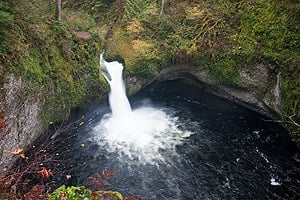
A punchbowl waterfall drops into a large, rounded basin that has been carved into the bedrock at the base of the fall. The defining feature is the bowl-shaped plunge pool, formed by swirling, erosive water over long periods of time. Water typically free-falls or drops steeply from a narrow lip, strikes the pool with force, then circulates within the basin before exiting downstream through a confined channel. Punchbowl waterfalls often appear compact and powerful, with smooth, sculpted rock walls, deep emerald or dark pools, and persistent mist rising from the impact zone.

In the Columbia River Gorge, notable punchbowl waterfalls include Punch Bowl Falls on Eagle Creek, the archetype of this waterfall type; Lower Oneonta Falls, which plunges into a rounded, enclosed basin; Metlako Falls, whose powerful drop feeds into a deep carved pool below; and Lower Punchbowl Falls on certain tributary streams within the Gorge that exhibit the same bowl-shaped erosion pattern during higher flows.

SEGMENT
A segmented waterfall is characterized by water that splits into two or more distinct channels as it descends, flowing side-by-side rather than as a single continuous sheet. The segments may separate at the lip due to rock protrusions or divide partway down as the water follows different grooves, ledges, or fractures in the cliff. Each segment maintains its own flow path, creating multiple parallel ribbons of water that may rejoin at the base or remain separate. Segmented waterfalls often have a complex, textured appearance, with exposed rock between channels, uneven flow widths, and varying drop speeds that emphasize the underlying geology.

In the Columbia River Gorge, good examples of segmented or strongly segmented waterfalls include Panther Creek Falls, where water divides into multiple parallel streams over a wide basalt face; Falls Creek Falls, which often breaks into distinct channels during moderate to high flow; Upper Bridal Veil Falls, where the water splits into separated strands as it descends; and Starvation Creek Falls, which frequently shows segmented flow as water threads down fractured rock.

TIER
A tier (tiered) waterfall descends in a sequence of distinct horizontal steps or rock ledges rather than a single uninterrupted drop. Water flows across one shelf, spills over an edge, lands on the next tier below, and continues downward in stages. This creates visible breaks in the flow, often with shallow plunge zones between levels. Tiered waterfalls have a layered, stepped appearance, with spread-out curtains of water, exposed stratified rock, dark wet stone surfaces, and localized mist forming mainly where water drops from one tier to the next.

In the Columbia River Gorge, notable examples of tiered or strongly tier-influenced waterfalls include Multnomah Falls, which features a dramatic two-tier structure with a large upper drop and a smaller lower tier; Wahkeena Falls, known for its multiple stepped cascades and angled tier transitions; Shepperd’s Dell Falls, a compact waterfall spilling cleanly over basalt ledges; Horsetail Falls, which often behaves as a tiered waterfall as water flows over several rock shelves; and Coopey Falls, a smaller but clearly defined tiered cascade with distinct step-like drops.